

The History of Marquetry and Inlay
Marquetry and inlay have been used for centuries to transform furniture from the functional into the extraordinary. From contrasting woods and delicate bands of decoration to elaborate pictorial scenes, these techniques have produced some of the most beautiful furniture ever made.
The history of inlay stretches back thousands of years. Ancient Egyptian craftsmen decorated objects by setting contrasting materials such as precious stones and metals into their surfaces to create patterns and scenes. The technique was known as intarsia and, after largely disappearing in Europe following the fall of the Roman Empire, decorative inlay would eventually enjoy a remarkable revival.
The Rise of Marquetry
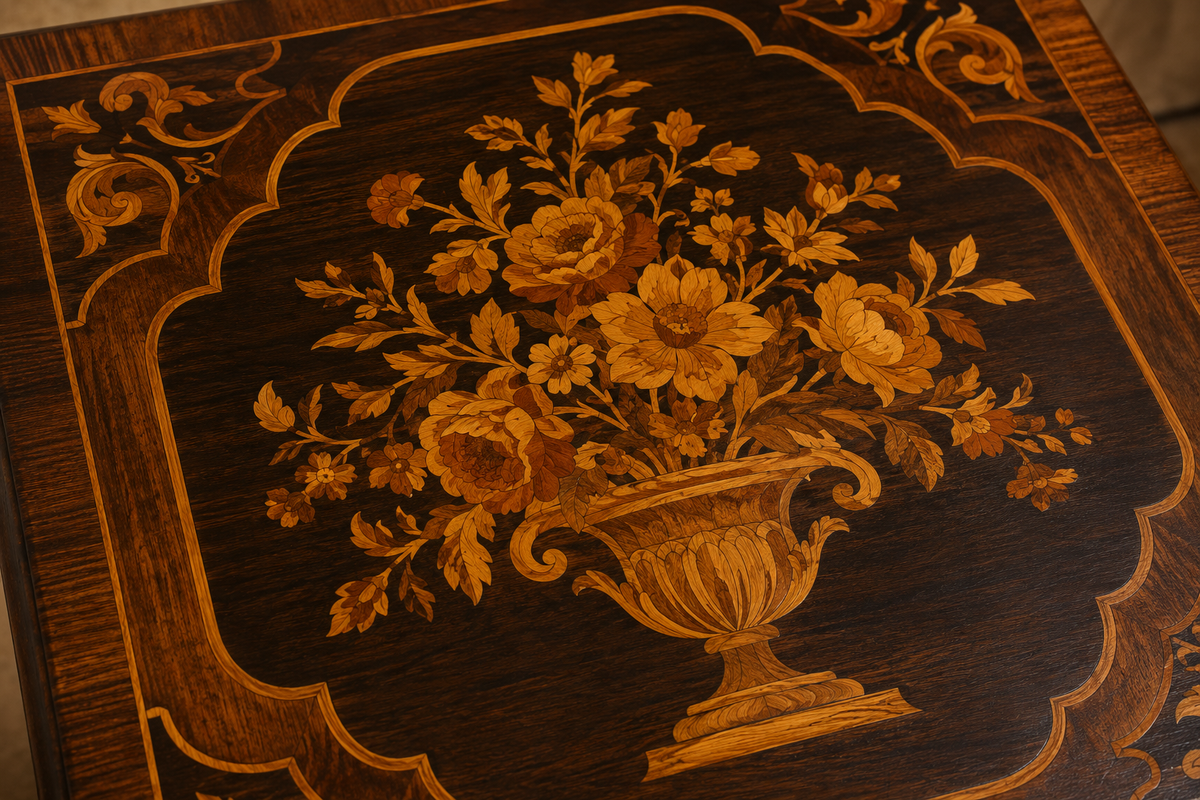
Marquetry developed into the art of creating decorative and pictorial designs using pieces of contrasting material—most famously different colored woods—applied to a wooden ground.
The craft became popular in Florence during the 14th century before spreading throughout Europe. It was painstaking work and consequently expensive, making elaborate marquetry furniture something generally reserved for those wealthy enough to afford it.
An important development came with the fret saw. Its fine blade made it possible for craftsmen to cut increasingly intricate shapes with much greater efficiency. The technique could now develop far beyond the relatively simple decorative inlays of earlier furniture.
And here's a little piece of trivia;: English mapmaker John Spilsbury is credited with creating an early jigsaw puzzle by mounting a map onto wood and cutting it into pieces using a marquetry saw. One for your next pub quiz!


Marquetry Becomes High Art
By the late 17th and early 18th centuries, marquetry had reached extraordinary levels of sophistication in France, encouraged by royal patronage.
One of the great names associated with the craft was cabinetmaker André-Charles Boulle (1642–1732). His distinctive work combined materials including metal, mother-of-pearl and tortoiseshell to produce exceptionally ornate surfaces. So influential was his work that the technique and style became known as Boulle work. Boulle received royal patronage from Louis XIV and produced furniture for Versailles.

The Dutch Influence
The Dutch became particularly accomplished practitioners of marquetry. Some of the most intricate forms included seaweed marquetry, or arabesque, characterized by elaborate scrolling patterns.
Dutch craftsmen brought their skills to England, and marquetry became established in London furniture following the Restoration of Charles II in 1660. It enjoyed another period of popularity with the rise of Neoclassical and French-influenced furniture in London during the later 18th century.
And, as we wrote in the original newsletter, the Dutch quickly became the experts "and probably told everyone how good they were!" We'll keep that line. With one Dutch owner at Streets of London Antiques, we're allowed a little bias.
Inlay in English Furniture
Inlay does not have to be extraordinarily elaborate to transform a piece of furniture.
Fine bands and patterns of contrasting woods—including fruitwoods, satinwood and dark ebony—can provide beautiful definition against mahogany and other cabinet woods.
Edwardian furniture can feature particularly fine and restrained inlay. Rather than dominating the furniture, narrow lines of contrasting timber can emphasize its shape and proportions.

So, What Is the Difference Between Marquetry and Inlay?
This is where things can become confusing.
Inlay is the broader decorative technique of inserting one material into the surface of another.
Marquetry uses pieces of contrasting material—particularly veneers of different woods—to create a decorative design or picture.
Or, as we put it in the original newsletter:
Marquetry can be inlay, but inlay is not necessarily marquetry.
A table with a decorative pinwheel made from contrasting woods and set into its top, for example, can appropriately be described as having marquetry inlay.
Hopefully that's cleared it up. In the original article we finished this explanation with: "I hope you now understand — I'm going for a lie down after that!"
Some things are worth preserving.
A Craft That Has Endured for Centuries
Part of the pleasure of handling antique furniture is seeing these techniques up close. What can initially appear to be a simple decorative detail often represents an extraordinary amount of skill, patience and craftsmanship.
From subtle lines of contrasting timber to elaborate floral arrangements and pictorial scenes, marquetry and inlay allow us to see not only how furniture was made, but also the changing tastes, techniques and influences of the craftsmen who created it.
Today, pieces incorporating these techniques continue to pass through Streets of London Antiques, giving us the opportunity to appreciate craftsmanship that has survived for generations.

Explore our current furniture collection to discover our latest finds, or visit our Cary, North Carolina showroom to see much more in person.

