

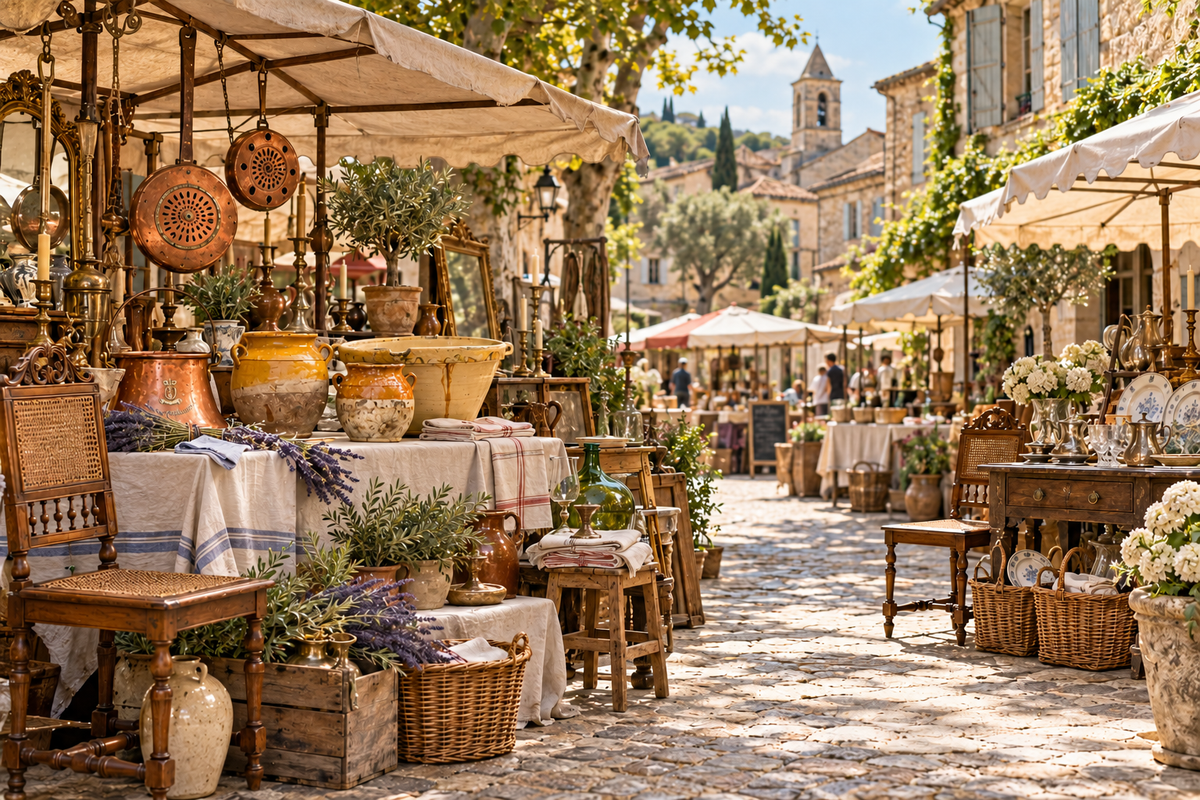
Journey Through French History Across Our Shop
From humble country kitchens to grand Parisian interiors, French antiques have an extraordinary ability to tell the story of everyday life and French craftsmanship. Travel with us as we take a rather less strenuous Tour de France across our showroom floor, discovering some fascinating French antiques along the way—no bicycle required.
(Click on any image to see more photographs and information about the item shown.)
Antique Pottery
Among the most beloved forms of French country pottery are the humble confit pot and the tian bowl—objects born not from luxury, but from everyday necessity. For centuries, confit pots were used throughout southwestern France to store duck, goose, and pork preserved in fat, long before the convenience of modern refrigeration.

Their distinctive form, often featuring a glazed upper section and an unglazed terracotta base, reflects generations of practical use in farmhouse kitchens and cool cellars. Today, collectors treasure these vessels not only for their warm honey and ochre glazes, but also for the evidence of lives well lived—the worn rims, subtle chips, and rich patina that speak to decades of faithful service.

Equally evocative is the French tian bowl, a wide, hand-thrown earthenware vessel that served countless purposes in the kitchens of Provence. Used for mixing ingredients, preparing food, washing vegetables, collecting milk, and all manner of other daily tasks, the tian was very much a workhorse of the French country kitchen.
And yet, for something designed to be thoroughly practical, the French somehow managed to make it rather beautiful too. With its generous proportions, warm glaze, and wonderfully simple form, the tian is a perfect example of French provincial design at its best.
Today, a tian or confit pot looks just as at home filled with fruit on a farmhouse table as it once did while hard at work in a Provençal kitchen—although these days, thankfully, considerably less work is expected of it.

We’ve just added three fabulous examples of this French history to the website. Click on the images to discover their stories and see all the details.
Better still, if you can make it into the shop, come and see them in person. Photographs are all very well, but there’s something rather special about standing in front of a piece that has already been around for well over a century—and has the character to prove it.
French Copperware
Before central heating, electric blankets, or even the humble hot-water bottle, there was the bed warmer—a wonderfully simple solution to the rather less wonderful experience of climbing into a freezing cold bed.
These long-handled warming pans were filled with hot embers or coals from the fire and carefully passed between the sheets before bedtime. The long handle allowed the pan to be moved back and forth across the mattress, spreading the warmth while keeping hands safely away from the hot copper.

Copper was particularly well suited to the job because it conducted heat quickly and efficiently. Many French examples were also beautifully made, with pierced or decorative lids that allowed heat to escape while helping to contain the glowing embers inside.
It sounds wonderfully cozy, although the combination of hot coals, bed linen and a wooden bed does make an electric blanket seem rather sensible by comparison.

Of course, French copper wasn’t only concerned with keeping toes warm. We also have these two traditional French copper cauldrons, one of which is marked Aurillac, a town in central France with a long association with skilled metalworking and copperware.

These were practical household objects, made to work hard in the kitchens of France. Many would have spent years over the heat of a stove or fire, and those years of use have left their mark in the rich patina, surface wear and character we admire today. Nobody was worrying about keeping the copper pristine for us a century or two later—and we’re rather glad they weren’t.

Today, these pieces have earned a somewhat easier retirement. Displayed in a country kitchen, beside a hearth, or on open shelving, they bring warmth, history and unmistakable French character to a room.
French Reflection

Few French antiques make quite the statement of a large antique mirror, and this one certainly doesn’t go unnoticed. Our 19th-century Louis Philippe mercury mirror dates from the Louis Philippe period, 1830–1848, a time when French furniture and interiors embraced a more restrained elegance than the elaborate styles that came before it.
The original mercury glass has developed the gentle foxing and variations so characteristic of genuinely old mirrors. Far from detracting from its beauty, these subtle imperfections give the glass a wonderful depth and softness—and provide a visible reminder of nearly two centuries of age.
A mirror of this scale was never simply functional. It reflected precious light, gave rooms a greater sense of space, and brought an unmistakable touch of grandeur to an interior. Nearly two centuries later, it still manages to do much the same thing—which is probably why you can’t walk past it in the shop without looking twice.
(This mirror is not yet listed online. If you are interested, please contact us for more information.)
Limoges Porcelain
Not many names in French porcelain are as celebrated as Limoges. Its story really began in the late 18th century with the discovery of kaolin nearby—the fine white clay essential for producing hard-paste porcelain. That discovery helped transform Limoges into one of Europe’s great porcelain centers.
The porcelain produced there became renowned for its brilliant white color, delicacy and translucency, and Limoges makers produced everything from elegant dinner services and vases to elaborate decorative pieces. Many were beautifully embellished with hand-painted flowers and landscapes, intricate designs and generous touches of gilding.

And the French being the French, once they had mastered making exceptionally fine white porcelain, leaving it simply white was apparently never going to be enough.

(This dinner service is not yet listed online. If you are interested, please contact us for more information.)
Today, Limoges remains highly collectible, not only for its beauty but for the remarkable craftsmanship found in each piece. It is a wonderful example of the French ability to turn even an everyday object into something truly decorative.
And there is certainly plenty of variety. In our collection, you’ll find everything from the luxurious tureen pictured above and impressive dinner services to delicate and highly collectible little trinket boxes—each with its own character and story to tell.

The hand-painted Limoges porcelain trinket box above, by Gérard Ribierre (G.R.), was created to commemorate the arrival of the new millennium in 2000. Wonderfully whimsical in design, it takes the form of a globe with four charming bears gathered around the top to welcome the new century.
And just when you think Limoges couldn’t get much more charming, along comes a wheelbarrow full of apples. Crafted by Artoria Limoges France, the delightful little trinket box below celebrates the harvest in miniature form.

Foray into French Furniture
French furniture has a long and rather glamorous history, from the highly ornamented pieces created for royal courts to the more intimate and graceful furniture found in country homes and elegant townhouses. Over the centuries, French makers developed a wonderful eye for proportion, beautifully shaped woodwork, sweeping curves and cabriole legs—details that gave even relatively practical pieces an unmistakable elegance.

And then there is our 19th-century chair.
This is exactly the sort of piece that makes French furniture so irresistible. With its beautifully figured, richly toned wooden frame, elegant cabriole legs and wonderfully curvaceous silhouette, it has unmistakable French character. It is decorative without being fussy, graceful without sacrificing comfort—and, frankly, far too pretty to be relegated to simply being a chair.
It is the sort of piece that can completely transform an otherwise forgotten corner of a room. Although once you put this chair there, it’s unlikely to remain a forgotten corner for very long.

French furniture, of course, wasn’t always about polished wood and elegant cabriole legs. Our two French wicker chairs show a rather more relaxed side of French life, where comfort and practicality were every bit as important as appearance.
Wicker and woven furniture became particularly popular for conservatories, verandas and informal interiors, offering lightweight, comfortable seating with a wonderfully casual charm. These two have the sort of relaxed character that immediately conjures up thoughts of a French country house, an open window and, perhaps, a glass of something chilled nearby.
They may be less formal than our 19th-century chair, but the French sense of style is still very much present. Apparently, even sitting around doing absolutely nothing can be made to look elegant.

Ooh La-La Lalique Glass
Moving into the 20th century, our journey through French decorative arts brings us to one of its most famous names—René Lalique. Originally celebrated as a jeweler, Lalique turned increasingly to glass, creating distinctive designs inspired by the natural world. Flowers, leaves, birds and other organic forms, combined with frosted surfaces and sculptural detail, became hallmarks of his work.
From Art Nouveau through Art Deco, Lalique’s imaginative use of texture, light and translucency helped make French glass some of the most recognizable decorative art of the 20th century.

Our own little example is this beautifully sculpted Lalique crystal swan ring holder, which can also be used as a pin tray or trinket dish. Signed “Lalique France” to the underside, it turns a practical little object into something rather special. Proof, perhaps, that even your rings deserve somewhere suitably French to spend the night.
From humble farmhouse pottery to elegant furniture and the artistry of Lalique, French antiques have a wonderful way of bringing their history with them. The wear, patina and little imperfections gathered along the way are all part of their story—and, we think, part of their charm.
So, if a trip to France isn’t quite on the cards this weekend, come and take a wander around the shop—or BROWSE OUR STORE ONLINE—no passport needed!

